

 Sep 20 2009, 02:20 AM, updated 16y ago


Introduction
» Click to show Spoiler - click again to hide... «

Picture from: http://en.wikipedia.org/wiki/Scorpion
To the average person, scorpions appear to be bizarre, unusual, and downright frightening creatures.
However, beyond an almost alien and formidable appearance, there is a fascinating and impressive creature.
Scorpions are among the world's most misunderstood and feared creatures, and this fact is certainly one of the biggest
obstacles against gaining support to conserve these animals. Human fear of scorpions is mainly derived from that fact
that scorpions have the ability to inject toxic venom. However, scorpions are not as dangerous as many people believe.
Out of the 1,500 scorpion species found around the world, only around 25 species are equipped with a venom that is powerful
enough to be lethal to humans.
Scorpions have venom as a means to quickly kill or immobilize prey. Scorpions can and do control how much venom they inject
during a sting as the venom is crucial for subduing prey. If the scorpion depletes all of its venom it will take several days to
restock the supply. Due to these facts, scorpions may not want to waste their valuable venom during defensive stings.
Stings occur in which no venom is injected, these are known as 'dry stings.'
Scorpions are not malicious creatures that stalk out humans to sting. Scorpions are also not usually aggressive creatures,
but rather wary, timid, and retiring. Most people are stung by scorpions when they accidently step on them, stick their hands
or feet into places that act as shelter for scorpions (such as under rocks, under debris, etc.) or when someone intentionally handles them.
Taking precautions such as always wearing proper footwear outdoors and never sticking your hands or feet into places that
may act as potential hides will greatly reduce the chances of receiving a scorpion sting. Common sense and caution outdoors
with help alleviate confrontations between humans and wildlife.
Conservation Concerns
» Click to show Spoiler - click again to hide... «
Scorpions are brilliantly resourceful and resilient creatures. Their superb ability to adapt and survive has allowed them
to withstand over 430 million years on the earth.
Human actions, however, have begun to drastically change the environment. The natural world is being destroyed, altered,
and degraded at an alarming rate. Scorpions are not immune to this. The following outlines the many human-induced threats
that scorpions face.
Habitat Destruction/Habitat Fragmentation

Picture from: http://science.howstuffworks.com/deforestation.htm/printable
The most serious issue affecting scorpions is the destruction of their natural habitat. Habitat loss and habitat destruction
are extremely significant issues for scorpions as many species are habitat specific and have well defined natural ranges.
Many areas, that were once suitable for scorpions to live, have now been destroyed. The most scorpion rich environments on
the earth are the deserts and the rainforests, and both of these areas are particularly sensitive to habitat destruction.
Natural regions within these habitats are quickly destroyed due to logging, agriculture, and developmental construction.
Natural habitats of all kinds are being lost at an alarming rate. Scorpions are literally losing their homes and they are losing them
rapidly.
Remaining natural habitats are often degraded and fragmented. Fragmentation occurs when healthy areas of habitat are isolated from one another. Scorpion populations are affected since gene flow between populations is prevented. Habitat degradation occurs when the natural habitat has been altered and degraded to such a degree that it is unlikely that any remaining scorpions will be able to survive.
According to Sissom and Hendrixson (2005) scorpions are certainly not the 'warm fuzzy' animals that the average person finds so appealing, and it is doubtful that the lay community will ever be much concerned about their conservation. Despite this, some scorpion species may eventually be threatened with extinction due to habitat destruction.
Traffic Mortality
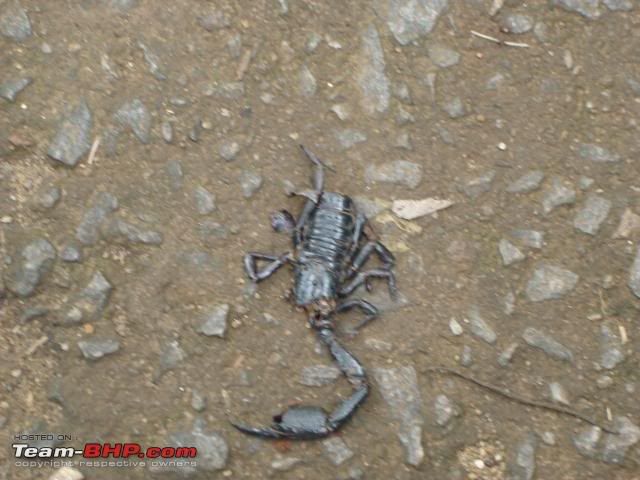
Picture from: https://www.team-bhp.com/forum/travelogues/...soon-magic.html
Habitats are often isolated and cut off from one another by the roads and highways that now run through them.
This is especially prevalent in desert habitats, which are rich in scorpion species. This leads to countless numbers of scorpions
being killed on roads and highways every year. In some cases, people will purposely swerve to run over scorpions.
Direct Killings
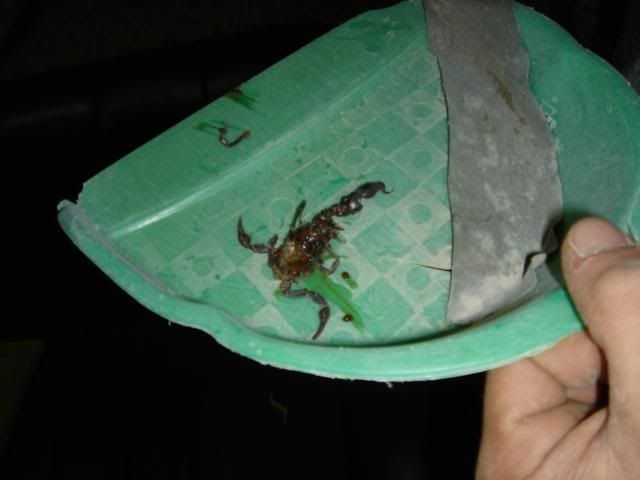
Picture from: http://travel.webshots.com/photo/1509898945081695802ckVGhN
Once the scorpions' natural habitat has been lost through construction for human developments and settlement,
the scorpions are forced into urban environments like people's houses and garages. Here the scorpions are deemed as
pests and destroyed. Scorpions may also be directly persecuted by individuals who are fearful of them.
Harvesting
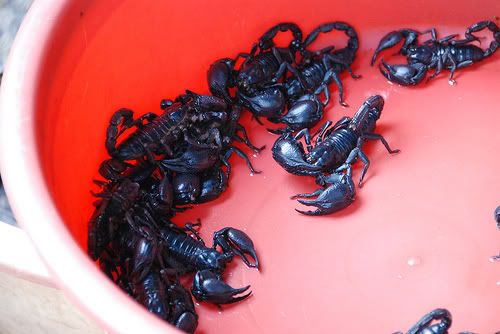
Picture from: http://www.flickr.com/photos/seb_shanna/2934346866/
The trade in live animals and animal products is also detrimental to scorpion populations. Scorpions are harvested from the wild
at a staggering rate. They are collected for the pet trade, food markets or to be used in traditional medicines. Well over 100,000
Emperor Scorpions (Pandinus imperator) are moved annually from Africa to other parts of the world to supply demands for the
pet trade. This represents only one species from one continent. Dozens of other species are highly sought after and these too are
harvested in significant numbers from areas in North America, Africa, and Asia.
Scorpions are also captured from the wild and then killed so that they can be made into various trinkets and souvenirs to supply
tourist markets. The extensive exploitation of scorpions is a tremendous problem that is certainly causing a huge stress on
natural populations.
Exploitation
Picture from: http://www.movieposter.com/poster/MPW-7561...e_Scorpion.html
Currently, there are no laws in the United States that protect invertebrates from cruelty, abuse, or death. This means scorpions are extremely vulnerable to human exploitation. According to author Manny Rubio's book 'Scorpions' (2008 Barron's Educational Series), humans kill millions of scorpions annually.
Scorpions are often used as 'props' in movies and shows. Here they may be subjected to any form of misuse and cruelty. A prime example is the 1996 film The Great White Hype, which contains a scene of two scorpions being run over and killed.
Vodka, containing dead scorpions, is a popular drink throughout the world and this market represents another sector in which scorpions are killed and exploitated for monetary value.
Scorpions on a stick are a popular food item for sale in many Asian markets. The most disturbing aspect of this is that the scorpions are left alive after they have been staked.
Scorpions are also used in various contests in which participants see how many live scorpions can be consumed in the shortest amount of time. Videos of these 'contests' have surfaced on many popular video-sharing websites. This has resulted in many copy-cat videos of people killing scorpions for shock value.
These videos are harmful for various reasons. Not only do they show people killing scorpions for 'entertainment', but it also promotes to viewers that the killing of animals for attention is entertaining and justifiable.
These contests and videos are just another prime example of the cruelty and exploitation that scorpions face from humans who generally view them as 'bugs' that do not deserve protection from such abuse.
Conclusion
to withstand over 430 million years on the earth.
Human actions, however, have begun to drastically change the environment. The natural world is being destroyed, altered,
and degraded at an alarming rate. Scorpions are not immune to this. The following outlines the many human-induced threats
that scorpions face.
Habitat Destruction/Habitat Fragmentation
» Click to show Spoiler - click again to hide... «
Picture from: http://science.howstuffworks.com/deforestation.htm/printable
The most serious issue affecting scorpions is the destruction of their natural habitat. Habitat loss and habitat destruction
are extremely significant issues for scorpions as many species are habitat specific and have well defined natural ranges.
Many areas, that were once suitable for scorpions to live, have now been destroyed. The most scorpion rich environments on
the earth are the deserts and the rainforests, and both of these areas are particularly sensitive to habitat destruction.
Natural regions within these habitats are quickly destroyed due to logging, agriculture, and developmental construction.
Natural habitats of all kinds are being lost at an alarming rate. Scorpions are literally losing their homes and they are losing them
rapidly.
Remaining natural habitats are often degraded and fragmented. Fragmentation occurs when healthy areas of habitat are isolated from one another. Scorpion populations are affected since gene flow between populations is prevented. Habitat degradation occurs when the natural habitat has been altered and degraded to such a degree that it is unlikely that any remaining scorpions will be able to survive.
According to Sissom and Hendrixson (2005) scorpions are certainly not the 'warm fuzzy' animals that the average person finds so appealing, and it is doubtful that the lay community will ever be much concerned about their conservation. Despite this, some scorpion species may eventually be threatened with extinction due to habitat destruction.
Traffic Mortality
» Click to show Spoiler - click again to hide... «
Picture from: https://www.team-bhp.com/forum/travelogues/...soon-magic.html
Habitats are often isolated and cut off from one another by the roads and highways that now run through them.
This is especially prevalent in desert habitats, which are rich in scorpion species. This leads to countless numbers of scorpions
being killed on roads and highways every year. In some cases, people will purposely swerve to run over scorpions.
Direct Killings
» Click to show Spoiler - click again to hide... «
Picture from: http://travel.webshots.com/photo/1509898945081695802ckVGhN
Once the scorpions' natural habitat has been lost through construction for human developments and settlement,
the scorpions are forced into urban environments like people's houses and garages. Here the scorpions are deemed as
pests and destroyed. Scorpions may also be directly persecuted by individuals who are fearful of them.
Harvesting
» Click to show Spoiler - click again to hide... «
Picture from: http://www.flickr.com/photos/seb_shanna/2934346866/
The trade in live animals and animal products is also detrimental to scorpion populations. Scorpions are harvested from the wild
at a staggering rate. They are collected for the pet trade, food markets or to be used in traditional medicines. Well over 100,000
Emperor Scorpions (Pandinus imperator) are moved annually from Africa to other parts of the world to supply demands for the
pet trade. This represents only one species from one continent. Dozens of other species are highly sought after and these too are
harvested in significant numbers from areas in North America, Africa, and Asia.
Scorpions are also captured from the wild and then killed so that they can be made into various trinkets and souvenirs to supply
tourist markets. The extensive exploitation of scorpions is a tremendous problem that is certainly causing a huge stress on
natural populations.
Exploitation
» Click to show Spoiler - click again to hide... «
Picture from: http://www.movieposter.com/poster/MPW-7561...e_Scorpion.html
Currently, there are no laws in the United States that protect invertebrates from cruelty, abuse, or death. This means scorpions are extremely vulnerable to human exploitation. According to author Manny Rubio's book 'Scorpions' (2008 Barron's Educational Series), humans kill millions of scorpions annually.
Scorpions are often used as 'props' in movies and shows. Here they may be subjected to any form of misuse and cruelty. A prime example is the 1996 film The Great White Hype, which contains a scene of two scorpions being run over and killed.
Vodka, containing dead scorpions, is a popular drink throughout the world and this market represents another sector in which scorpions are killed and exploitated for monetary value.
Scorpions on a stick are a popular food item for sale in many Asian markets. The most disturbing aspect of this is that the scorpions are left alive after they have been staked.
Scorpions are also used in various contests in which participants see how many live scorpions can be consumed in the shortest amount of time. Videos of these 'contests' have surfaced on many popular video-sharing websites. This has resulted in many copy-cat videos of people killing scorpions for shock value.
These videos are harmful for various reasons. Not only do they show people killing scorpions for 'entertainment', but it also promotes to viewers that the killing of animals for attention is entertaining and justifiable.
These contests and videos are just another prime example of the cruelty and exploitation that scorpions face from humans who generally view them as 'bugs' that do not deserve protection from such abuse.
Conclusion
» Click to show Spoiler - click again to hide... «
A massive number of scorpions are being lost each year through the combination of the many threats mentioned above.
According to Polis & Farley (1979) and Polis (1990), scorpions have small litter sizes, long generation times and low survivorship
among sexually immature females. This contributes to a low rate of population increase for most species. This makes it
especially hard for populations to rebound from unnatural declines, which makes scorpions particularly sensitive to the threat
of extirpation and extinction
According to Polis & Farley (1979) and Polis (1990), scorpions have small litter sizes, long generation times and low survivorship
among sexually immature females. This contributes to a low rate of population increase for most species. This makes it
especially hard for populations to rebound from unnatural declines, which makes scorpions particularly sensitive to the threat
of extirpation and extinction
How You Can Help
» Click to show Spoiler - click again to hide... «
Legions of scorpions die on the roads every year. When driving through roads that cut through scorpion habitat, slow down and
be watchful for any roadbound individuals.
If you see any products that contain dead scorpions in them (trinkets, scorpion vodka, etc) do not buy them. Even if you try to justify
that you did not kill the animal, you are supporting the demand and another scorpion will have to be killed to replace the purchased item.
Refusing to shop at stores that stock these items is also beneficial.
Do not use all-terrain or off-road vehicles to drive on sandunes or through fragile desert habitat. Although deserts seem like harsh and
rugged places, they are actually sensitive environments that can be easily damaged. Using such vehicles can degrade delicate scorpion
habitat.
be watchful for any roadbound individuals.
If you see any products that contain dead scorpions in them (trinkets, scorpion vodka, etc) do not buy them. Even if you try to justify
that you did not kill the animal, you are supporting the demand and another scorpion will have to be killed to replace the purchased item.
Refusing to shop at stores that stock these items is also beneficial.
Do not use all-terrain or off-road vehicles to drive on sandunes or through fragile desert habitat. Although deserts seem like harsh and
rugged places, they are actually sensitive environments that can be easily damaged. Using such vehicles can degrade delicate scorpion
habitat.
Benefits of Scorpions
» Click to show Spoiler - click again to hide... «
Raising awareness about the issues that cause population declines in scorpions is important as these creatures are very beneficial.
Scorpions are extremely valuable components to natural Eco-systems, as they play complex roles of both predators and prey.
Scorpions also act as natural gauges for environmental degradation. When scorpions cease to turn up in habitats that should support
them, it is a strong indicator that the environment has been severely degraded. In this respect, scorpions act like 'the canary in the
coal mine' for certain natural habitats.
Scorpions are also valuable to medical research. The venoms of several different species are being looked at as they may be instrumental
in the creation of new antibiotics and various cancer treatments.
Below is a video about scorpion venom in treating cancer
Scorpions are extremely valuable components to natural Eco-systems, as they play complex roles of both predators and prey.
Scorpions also act as natural gauges for environmental degradation. When scorpions cease to turn up in habitats that should support
them, it is a strong indicator that the environment has been severely degraded. In this respect, scorpions act like 'the canary in the
coal mine' for certain natural habitats.
Scorpions are also valuable to medical research. The venoms of several different species are being looked at as they may be instrumental
in the creation of new antibiotics and various cancer treatments.
Below is a video about scorpion venom in treating cancer
Derive from: http://scorpionconservation101.weebly.com/
 Quote
Quote









 0.0308sec
 0.74
0.74
 6 queries
 GZIP Disabled